UGC Playbook for Beauty & Skincare Brands (The Highest-Converting Framework)
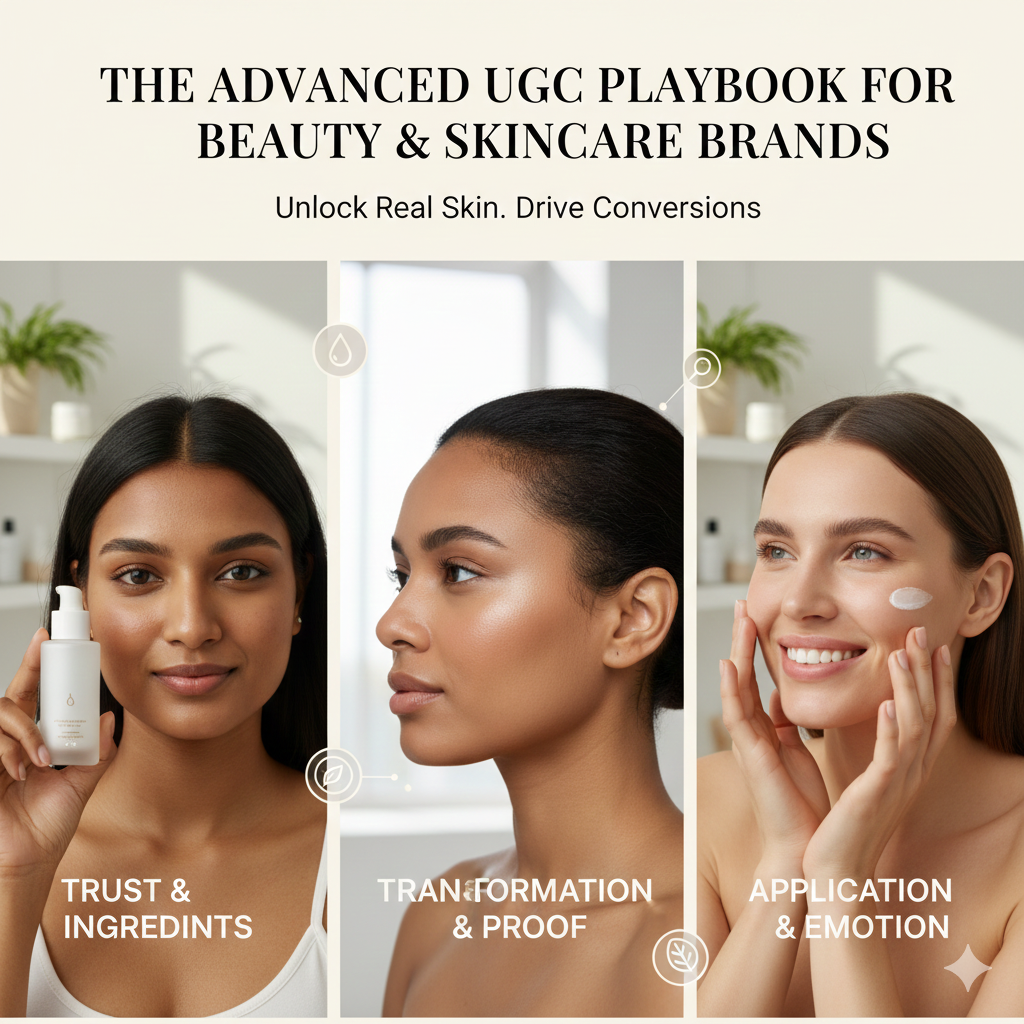
Beauty and skincare is the #1 industry where UGC consistently outperforms influencers, studio shoots, and brand-led campaigns.
Why?
Because skincare is PERSONAL.
People don’t trust perfect models.
They trust real skin, real people, real results.
This blog breaks down the complete UGC playbook for beauty & skincare brands, used by top D2C companies like:
- Mamaearth
- Plum
- Minimalist
- Dot & Key
- WOW
- Oziva
- Pilgrim
This is an advanced framework — not the basic UGC blogs seen on the internet.
Let’s begin.
⭐ Why UGC Works Best for Skincare Brands
Beauty buying decisions are based on:
- trust
- identity
- relatability
- social proof
UGC delivers all three using:
✔ Real faces
✔ Real skin texture
✔ Authentic reviews
✔ Demonstration of results
✔ Storytelling
✔ Ingredient explanation
Studio ads cannot do this.
⭐ The Complete UGC Playbook for Beauty & Skincare Brands
(Advanced 6-Part Framework)
This playbook includes:
- The 3-Pillar Beauty UGC Framework
- 7 High-Converting Video Angles
- Shot List Checklist
- Creator Selection Formula
- Emotional Anchoring Methods
- Ad Funnel + Creative Testing Strategy
Let’s break each down.
⭐ 1. The 3-Pillar Beauty UGC Framework
Beauty UGC must satisfy these three pillars:
✔ Pillar 1 — TRUST
People want to know:
- Is this creator real?
- Is their skin real?
- Is this story truthful?
✔ Pillar 2 — PROOF
People want to see:
- texture
- application
- before-after
- results
✔ Pillar 3 — EXPLANATION
People want to understand:
- ingredients
- how it works
- for whom it works
- when to use it
The UGC must balance all three pillars.
⭐ 2. 7 High-Converting Skincare UGC Angles
These angles convert the highest across beauty brands:
⭐ 1. Ingredient Breakdown Angle
Explain the key actives:
- niacinamide
- salicylic acid
- peptides
- hyaluronic acid
Consumers love ingredient science.
⭐ 2. Transformation Angle (Before→After)
Shows visible skin progress.
One of the strongest ad angles.
⭐ 3. Routine Replacement Angle
“Replaced my toner + serum with this one product.”
Shows convenience.
⭐ 4. Problem–Solution UGC
Hyper-specific pain points:
- acne marks
- dullness
- open pores
- pigmentation
- dryness
This resonates deeply.
⭐ 5. Texture Application Angle
Show texture → apply → absorb → glow.
This increases trust.
⭐ 6. Dermat-Style UGC
Creators act like skin experts explaining:
- ingredients
- skin types
- routines
Works extremely well for thoughtful audiences.
⭐ 7. Real Story Angle
Creators share a personal journey:
“I’ve struggled with acne for 6 years…”
Authenticity = instant trust.
⭐ 3. Essential Beauty UGC Shot List (Advanced)
Here’s a shot list that every beauty brand MUST include:
✔ Face close-up (natural lighting)
✔ Unboxing
✔ Texture on fingers
✔ Applying on face
✔ Rubbing into skin
✔ Before-after comparison
✔ Ingredient text overlay
✔ Benefits text
✔ Creator talking to camera
✔ Emotion reaction shot
✔ Routine shot (morning/evening)
✔ CTA shot
Missing any of these reduces conversion.
⭐ 4. Creator Selection Formula for Beauty UGC
Creators matter a LOT in skincare UGC.
Use this formula:
✔ 1. Skin Type Match
Dry / Oily / Sensitive / Combination
✔ 2. Identity Match
Teenager? Working woman? Mom? Influencer? Student?
✔ 3. Emotion-Friendly Facial Expressions
Soft, warm, relatable expressions convert the best.
✔ 4. Camera-Facing Confidence
Not scripted or forced.
✔ 5. Real Skin Imperfections
Textured skin performs 3–4× better than flawless skin.
✔ 6. Voice Tone
Calm + soft = best for beauty.
⭐ 5. Emotional Anchoring for Beauty Brands
Beauty content must anchor emotions:
- confidence
- relief
- self-love
- transformation
- insecurity
- validation
Example lines:
“I feel so much more confident leaving home without makeup.”
“This finally calmed my irritation.”
“My skin has never felt this healthy.”
Emotion → Action.
⭐ 6. UGC Ad Funnel for Beauty Brands
Best funnel structure:
⭐ TOF (Top-of-Funnel)
- problem hooks
- routine hooks
- story hooks
- ingredient-focused
Goal: stop scroll + build curiosity.
⭐ MOF (Middle-of-Funnel)
- demos
- ingredient breakdowns
- before-after
- testimonials
Goal: build trust.
⭐ BOF (Bottom-of-Funnel)
- testimonial UGC
- offer ads
- limited-time CTA
- comparison UGC (A vs B)
Goal: convert.
⭐ Advanced Creative Testing Strategy
Beauty brands should test:
✔ Hooks → 5 versions
✔ Creators → 4 creators
✔ Editors → 3 editing styles
✔ Scripts → 3 angles
✔ CTAs → 2 endings
This gives 120+ variations from one concept.
This is how you scale beauty brands profitably.
⭐ Conclusion
Beauty & skincare UGC is the most competitive and the most profitable category — but only when executed using a professional playbook.
This advanced playbook gives beauty brands:
✔ Stronger hooks
✔ Stronger emotional anchoring
✔ Better creator selection
✔ Higher retention
✔ Higher conversions
✔ Higher ROAS
UGC is not optional in beauty —
UGC is the main engine of brand growth.
Want Beauty-Focused UGC for Your Brand?
If your beauty or skincare brand needs UGC frameworks, scripts, ingredient-focused content, creator selection, or ad-ready videos, reach out to Creator Navigator — we specialize in high-performance beauty UGC.