UGC for Apps & SaaS Brands: The Complete High-Performance Framework
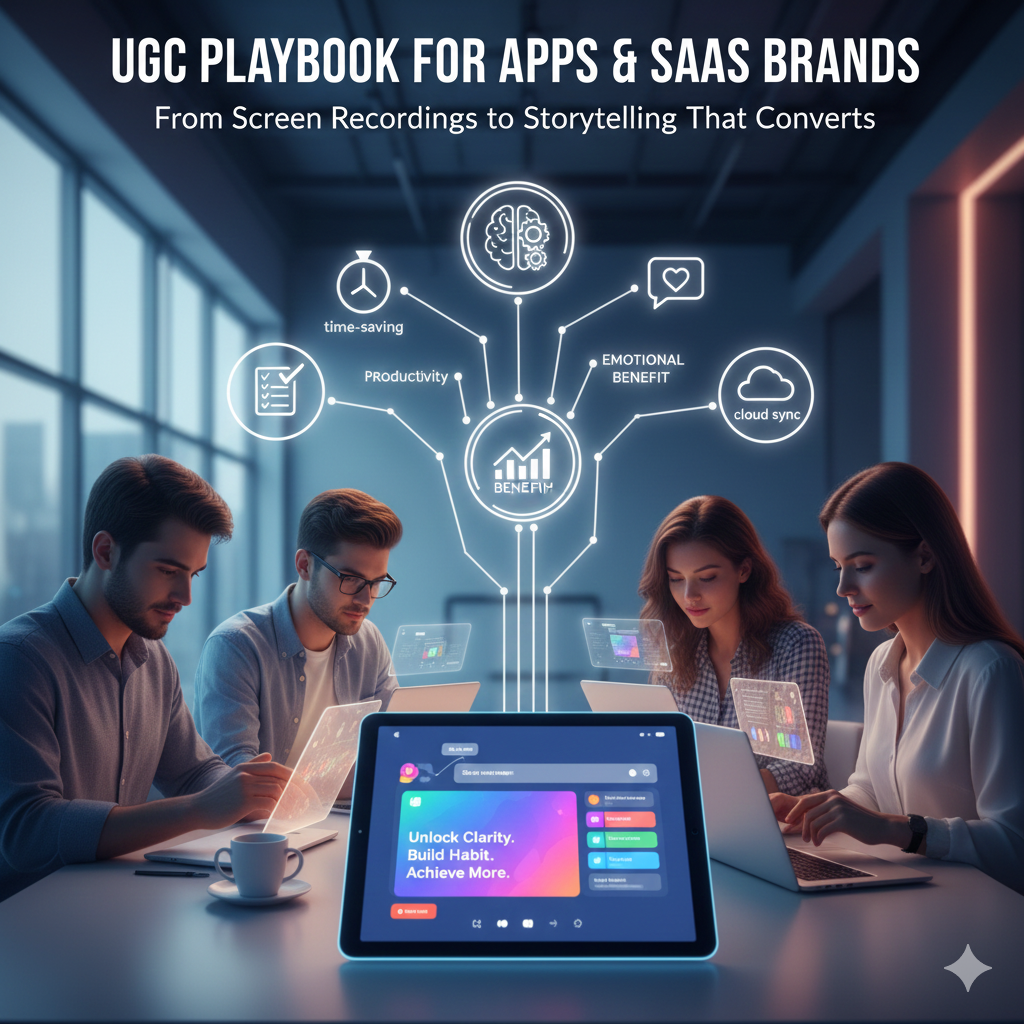
Apps and SaaS products are very different from beauty, fitness, or fashion.
Users don’t buy because of “emotion” alone — they buy because of:
✔ clarity
✔ usefulness
✔ problem-solving
✔ simplicity
✔ time-saving
✔ habit formation
UGC for apps must focus on a hybrid of emotional + functional elements.
Most app founders rely only on:
❌ App store screenshots
❌ Feature videos
❌ Generic demo tutorials
But top apps grow using:
⭐ UGC storytelling
⭐ UGC demos
⭐ UGC POV experiences
⭐ UGC habit-building narratives
This blog gives you the complete UGC framework for Apps & SaaS brands.
⭐ Why UGC Works for Apps & SaaS (The Real Reason)
Apps are intangible. You can’t show:
- texture
- physical results
- transformations
So UGC helps make apps FEEL real by showing:
✔ Real people using the app
✔ Real problems being solved
✔ Real results from usage
✔ Real situations where the app helps
✔ Real screen recordings
UGC gives apps a personality.
⭐ The Complete App/SaaS UGC Framework (Advanced Model)
This framework includes:
- UGC Funnel Structure
- Best Performing Video Angles
- Creator Selection
- Script Structure for High ROAS
- Screen Recording Guidelines
- Testing & Scaling Strategy
Let’s break each down.
⭐ 1. The UGC Funnel for Apps
✔ TOF (Awareness)
Goal → show “WHY this app matters”
Type → story-based, POV, emotional hooks
✔ MOF (Consideration)
Goal → show “HOW it works”
Type → demos, feature breakdowns, tutorials
✔ BOF (Conversion)
Goal → show “WHY you should download now”
Type → testimonial, results, social proof
The funnel must be content-rich.
⭐ 2. The 7 High-Converting UGC Angles for Apps
These angles consistently outperform others:
⭐ 1. POV Problem Hook
“POV: You keep forgetting your tasks…”
This works extremely well for productivity apps.
⭐ 2. Real Usage Demo
Creators record their screen while using the app:
- swiping
- clicking
- opening features
- showing results
⭐ 3. “This changed my daily routine” Angle
Perfect for:
- wellness
- habit-building apps
- journaling apps
- meditation apps
- fitness trackers
⭐ 4. Before–After Productivity Angle
“I used to miss deadlines — here’s what changed.”
⭐ 5. Feature Breakdown (But Simplified)
Apps often overwhelm users.
Break down only the top 3 features.
⭐ 6. Story-Based UGC
“My biggest problem last year was budgeting… until I found this app.”
People relate deeply to stories.
⭐ 7. Social Proof UGC
“3M users… #1 productivity app… Featured on Play Store…”
This reduces hesitation significantly.
⭐ 3. Creator Selection Formula for Apps
Apps don’t require “beauty” features.
Creators must have:
✔ clear voice
✔ good screen recording skills
✔ relatable daily routines
✔ professional tone
✔ clean lifestyle aesthetics
✔ trust-driven camera presence
Best performing creators:
- Students
- Working professionals
- Tech-savvy personalities
- Young adults with clean backgrounds
- Minimalist lifestyle creators
⭐ 4. Script Structure for High-Performance App UGC
Use this 5-step script formula:
STEP 1 — Hook (Problem/Situation)
“If you constantly forget your deadlines… this app is for you.”
STEP 2 — App Demo (Screen Recording)
Show app usage, not static screenshots.
STEP 3 — Key Features (3 highlights max)
“I love it because it gives reminders, color-coded tasks, and sync across devices.”
STEP 4 — Emotional Benefit
“This app actually reduced my daily stress.”
STEP 5 — CTA (Simple & direct)
“Download it — it’s free.”
This structure is proven.
⭐ 5. Screen Recording Guidelines (Must-Follow)
✔ Use 1080p screen recording
✔ Avoid notifications
✔ Use steady pace scrolling
✔ Highlight buttons with finger taps
✔ Use callout text:
- “Add task”
- “Set reminder”
- “Track progress”
✔ Add soft background music
✔ Keep demo under 20 seconds
Clean visuals = higher installs.
⭐ 6. UGC Testing Grid for Apps
Test variations across:
✔ 5 Hooks
✔ 3 Creators
✔ 3 Demo versions
✔ 2 CTA versions
= 90 variations from one concept.
Apps need variety to find winners.
⭐ 7. Scaling Strategy for Apps
✔ TOF Scaling Signal:
Hook rate 30%+
✔ MOF Scaling Signal:
Retention 40–50%
✔ BOF Scaling Signal:
Install Rate ↑
CPI ↓ (Cost Per Install)
Increase budget slowly:
10–20% every 48 hours.
⭐ Examples of High-Performance App Hooks
“POV: You keep forgetting your deadlines.”
“This app saved me 1 hour EVERY day.”
“I can’t believe this is free…”
“If you also struggle with budgeting, watch this.”
“This app completely changed my routine.”
⭐ Conclusion
UGC for Apps/SaaS is not just screen recording —
It’s a storytelling system that connects emotion to functionality.
The advanced UGC playbook helps your app:
✔ Get more downloads
✔ Lower CPI
✔ Increase retention
✔ Boost reviews
✔ Improve trust
✔ Build habit loops
Apps don’t grow accidentally.
They grow when UGC makes them feel useful + personal + emotional.
⭐ CTA — Want UGC for Your App or SaaS Brand?
If your app needs UGC demos, screen-recorded content, high-converting scripts, or ad-optimized creatives, reach out to Creator Navigator — we create performance-focused UGC for tech brands.